Siderise Case Study: Anchorage Gateway
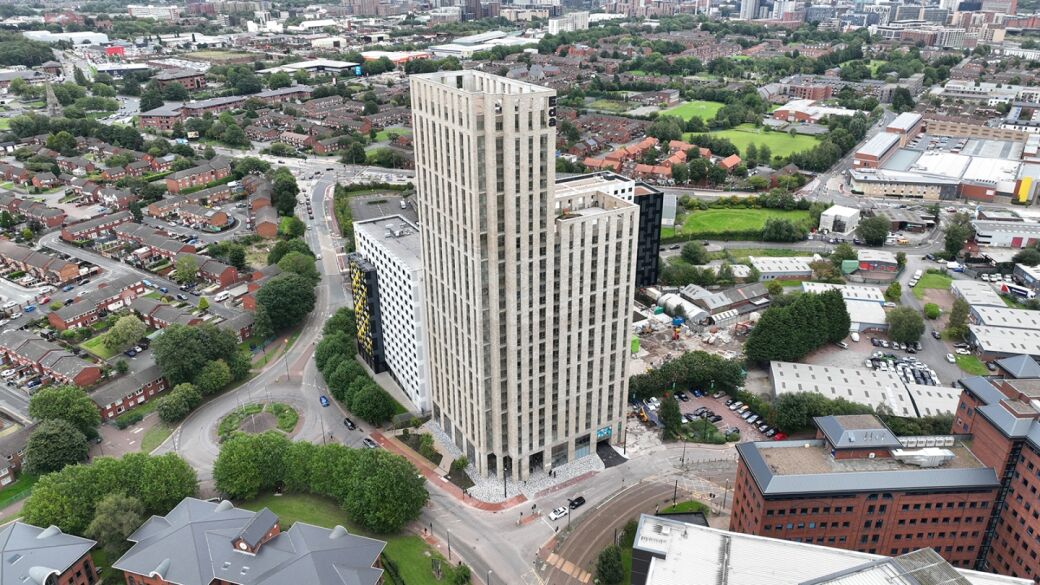
This 29-storey residential high-rise, completed three months ahead of schedule, is set to be the tallest residential brickwork building in the UK. Yet, behind this traditional brick façade finish is a design that demanded a modern approach to diverting moisture from the cavity to the outside of the building, using construction methods far more efficient than the conventional.
Design and specification
Representing the gateway entry point into Salford Quays, the build-to-rent (BTR) Erie Dock Apartments (Eda) development replaced a vacant four-storey office block of 1990s construction with a building designed to offer a truly contemporary residential experience. Hosting 290 apartments of various sizes and private amenities such as co-working spaces, a fitness studio, a screening room, and more, it was important that the building’s exterior reflected a feeling of home and community, giving it a sense of place in this rapidly developing part of the city.
The building’s L-shaped footprint is emphasised by the use of stepped massing, with the slimmer block extending to the top of the building and external rooftop terraces at the crown of each ‘block’. Each elevation is constructed from pale-coloured brickwork, supported by an SFS System and concrete core works, giving the building a solid and striking, yet clearly domestic feel in an area dominated by glazing and cladding.
Moisture management is a fundamental element of any masonry construction, and cavity trays must be installed to ensure that any rainwater entering the wall cavity through the external brickwork is directed away from the inner structure, reducing the risk of internal damp and mould. Main contractor, Domis Construction, and brickwork contractor, Kinlan, had previously been using the traditional approach comprising metal cavity trays packed on-site with non-combustible insulation. However, in their search for a more efficient method that could improve the speed and cost of delivery without compromising on quality, they came across Siderise CT Cavity Tray.
After carrying out their due diligence, the team engaged the Siderise Site Services to deliver training onsite, which included a benchmark installation. It was then that Domis Construction and Kinlan realised the huge labour and time-saving benefits Siderise CT Cavity Tray could offer and that ‘it did what it said on the tin’. The factory-engineered system was subsequently trialled on a section of another Salford project before being put forward to the fire consultants and building control officers for the high-rise Anchorage project.
The CT Cavity Tray achieves an A2-s1, d0 reaction to fire classification to EN 13501-1, is BBA certified and can comply with NHBC, LABC and Premier Guarantee warranty requirements.
David Ashworth, Project Manager, Domis Construction explained:
“Siderise CT Cavity Tray has been a gamechanger for us. We’d been using traditional all-metal cavity trays, site-formed and pre-formed. Even though we’d used Siderise Cavity Barriers and Firestops before, we were somewhat unsure about this single-fix tray and insulation combo at first. Nevertheless, we researched the product, confirming that it met regulatory compliance criteria and seeing the potential benefits in terms of time saving ability, labour cost reduction, and scaled-down site complexities associated with specialist tools, equipment, and segregated workshop areas for onsite fabrication.”
Installation and inspection
Over 3,200 units of Siderise CT Cavity tray were used on the project, helping to realise installation benefits that carried real value for the project. On previous projects where traditional cavity tray solutions were used, the installation teams would need to share masts with the bricklayers on a 50/50 circa ratio. This meant that the bricklayers would take longer to complete their job, due to the time it would take to form and fit the cavity trays, as well as other products, ahead of them.
By using the pre-engineered Siderise CT Cavity Tray, which combines a flexible aluminium tray with non-combustible insulation, the installation team was able to install this lightweight element much faster with just a cutting knife and sealing tape for joining at details such as corners or windows. The requirement for specialist equipment, isolated onsite workshop zones, vast site storage facilities, soldering, sealants and installing insulation as a separate fix and was eliminated, enabling them to free up mast usage, with an estimated ratio of 70/30 in the bricklayers’ favour, speeding up the build programme.
David Ashworth, Project Manager, Domis Construction added:
“Working with our brickwork contractor, Kinlan, the Siderise Site Services team came down and delivered an in-person practical training programme before the install and it was during this in-depth session that we started to realise the operational advantages it would have.Siderise Site Services have been supporting us continually on the build, checking how we are installing their product and giving us any advice necessary to ensure a top-class delivery.”
Conclusion
Anchorage Gateway demonstrates, with tangible evidence, how traditional building methods can be improved using modern products that have been engineered and tested to meet the demands of contemporary construction, allowing the creation of beautiful brickwork buildings without sacrificing on speed or quality of build.
Details
Year: 2023
Location: Salford, Greater Manchester, UK
Application: Masonry
Building use: Residential
Developer: Cole Waterhouse
Architect: Chapman Taylor (Design), Jon Matthews Architects (Delivery)
Main contractor: Domis Construction
Façade contractor: Kinlan Brickwork
Products used: CT Cavity Tray